Clarity that defines precision
Creating Optical Performance Starts at the Mould Surface
Optical moulding applications are among the most demanding applications for mould manufacturing.
Whether the final component is a VR lens, a smartphone camera lens, a smart glasses component or a medical optical device, the quality requirements placed on the mould are significantly higher than for conventional plastic parts. Optical polymers such as PMMA, PC and COC/COP require excellent surface replication and extremely high mould surface quality to meet optical performance requirements.
The mould surface must often achieve a mirror-quality finish, typically corresponding to SPI-A1 standards and extremely low surface roughness values. Any imperfection on the cavity surface can be transferred directly to the moulded part, making polishing one of the most critical steps in the manufacture of optical moulds.
The challenge is not simply how to polish a mould, but how to achieve the required optical surface quality with maximum efficiency, consistency, and repeatability. This is where the choice of steel makes all the difference.
The ideal steel for optical moulds combines:
- Exceptional cleanliness
- An ultra-fine and homogeneous microstructure
- Outstanding hardness uniformity
- A highly consistent and reliable polishing response
These characteristics help mould makers achieve demanding surface requirements while reducing the risk of polishing defects and unnecessary rework.
As optical applications become more advanced, the demands placed on mould surfaces continue to increase. Mobile phone camera modules now contain multiple lenses and increasingly complex optical systems, placing even greater importance on mould quality and material purity. The same trend can be observed in AR/VR equipment and other advanced optical applications.
Key Message
In optical moulding, surface quality is not created by polishing alone. It starts with selecting a mould material capable of achieving and supporting the required optical finish.
Supporting Case Study
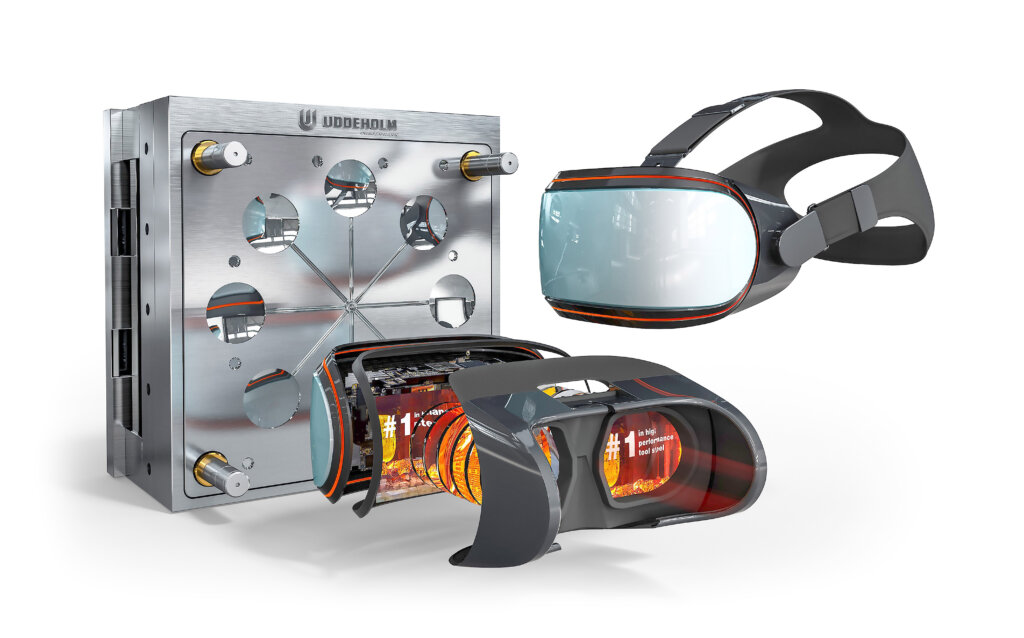
A VR lens application processing PC and PMMA compared Stavax ESR with a competing material. The application required optical quality surfaces and long production life. During evaluation, Stavax ESR achieved approximately 1 million shots, while the competing material reached approximately 800,000 shots and experienced polishing pits and plastic deformation. The customer also highlighted the superior heat treatment stability achieved with Stavax ESR.
In one PMMA spectacle lens application, a mould insert with an A1 surface finish was evaluated using Tyrax ESR and compared with a conventional solution. The application required both high optical quality and stable production performance over an extended period.
During operation, the reference solution required polishing maintenance after approximately 200,000 shots. By comparison, the Tyrax ESR insert remained in production beyond 250,000 shots at the time of reporting, without any maintenance requirement being recorded.
______________________________________
Maintaining Optical-quality Performance Over Time
Producing an optical quality mould surface is a significant engineering achievement, but true performance is measured by how well that surface maintains its precision and integrity throughout the life of the mould
Achieving optical quality at the start of production is only the first milestone. The real test is sustaining that same level of surface excellence and part consistency after hundreds of thousands, or even millions of moulding cycles. That is where durability, reliability and manufacturing excellence make the difference.
This is especially critical for optical applications where exceptional clarity and consistency are non-negotiable, including mobile phone lenses, VR optics, smart glasses, and medical optical components. In medical devices, even subtle changes in mould surface condition can affect optical performance, image quality and product reliability. As a result, optical moulds are often required to sustain extended production runs while consistently maintaining ultra-high surface quality and dimensional accuracy.

During production, mould surfaces are continuously exposed to:
- Abrasion from polymer flow
- Gate erosion and wear
- Processing-induced mechanical stresses
- Repeated heating and cooling cycles
Over time, these factors can gradually affect the polished surface of the mould. The effects are rarely seen as a sudden failure. Instead, they often emerge as a gradual decline in performance, leading to:
- More frequent maintenance requirements
- Increased polishing intervals
- Difficulties in maintaining consistent part quality
- Higher tooling and lifecycle costs
This is where wear resistance becomes a critical consideration. For optical moulds, wear resistance is not only about extending tool life. It is about preserving the quality of the mould surface for as long as possible and maintaining consistent production performance. Wear-resistant mould materials can help preserve polished surfaces, extend maintenance intervals, support consistent optical quality and improve long-term productivity. In other words, wear resistance helps protect the investment already made in achieving the optical surface.
Key Message
Achieving optical quality is only the beginning. The real challenge is maintaining that quality throughout the life of the mould.
Supporting Case Study
In the production of medical feed set adapters made from copolyester, optical clarity is a critical quality requirement. Transparent components enable healthcare professionals to visually verify fluid flow and quickly detect air bubbles, contamination, or blockages, helping to support patient safety during medical procedures. Achieving this level of clarity requires a highly polished, mirror-finish mould surface, as even minor wear, corrosion, or surface imperfections can be replicated onto the moulded part and reduce transparency.
To maintain this demanding surface quality over extended production runs, Tyrax ESR was evaluated against conventional tool steels S7 and 420 stainless steel in a high-volume injection moulding application. While the reference steels reached a tool life of approximately 6 million parts, Tyrax ESR delivered more than 25 million parts, achieving over four times the service life while maintaining the polished mould surface required for clear, defect-free medical components. This exceptional performance translates into longer uninterrupted production, significantly reduced maintenance and polishing requirements, lower tooling costs, and consistent production of high-clarity medical feed set adapters throughout the tool’s lifetime.
| Tool Material | Reference Tool Steel S7 | Reference Tool Steel 420 SS | Tyrax ESR |
|---|---|---|---|
| Hardness | 52-54 HRC | 50-52 HRC | 54 HRC |
| Tool Life (parts) | 6,000,000 | 6,000,000 | 25,600,000 |
| Failure Mode | Wear showing at 95 K shots | Wear showing at 95 K shots | Still running at 1.6 million shots |
______________________________________
Stability Beyond Polishing
When discussing optical moulds, surface quality often gets most of the attention. However, achieving a mirror-polished surface is only part of the equation.
Optical components such as mobile phone camera lenses, VR lenses, smart glasses and medical optical devices also require extremely high dimensional accuracy. Even small dimensional variations can influence lens geometry, focal performance or part consistency. Optical moulding therefore places demanding requirements not only on surface quality, but also on the dimensional stability of the mould itself.
Dimensional stability becomes important throughout the entire mould manufacturing process. As optical components continue to become smaller and more sophisticated, mould tolerances become increasingly critical. The mould must not only achieve the required geometry but also maintain it consistently.
This is why mould steels for optical applications are expected to provide:
- Low distortion after heat treatment
- Uniform hardness
- Good thermal stability
- Predictable dimensional behaviour

Tyrax ESR is designed to provide the dimensional stability required for demanding optical moulding applications. Its homogeneous microstructure, excellent heat treatment response, and predictable dimensional behaviour help mould makers minimize distortion during manufacturing and maintain critical geometries throughout the life of the mould.
For applications such as smartphone camera lenses, VR optics, and medical optical components, this helps support consistent lens quality while reducing correction work, process variability, and manufacturing risk.
Key Message
In optical moulding, precision is not only about achieving the right geometry. It is about maintaining that geometry throughout mould manufacturing and production.
Supporting Case Study
Modern smartphones continue to increase both the number and sophistication of camera modules. Today’s optical systems require highly precise lens geometries, tight tolerances and consistent manufacturing quality throughout the mould lifecycle.
For mould makers, maintaining dimensional accuracy is just as important as achieving the required surface finish. Any distortion during heat treatment, machining or production may affect lens geometry and ultimately influence optical performance. This places high demands on steel quality, heat treatment stability and dimensional control.
______________________________________
Enabling the Next Generation of Optical quality Moulding
The requirements for optical quality moulding continue to advance. Applications such as smart glasses, AR/VR devices, advanced sensors and medical optics are becoming increasingly sophisticated. At the same time, manufacturers are being asked to deliver higher optical quality, shorter cycle times and greater process stability.
This raises an important question: “Can traditional tooling approaches continue to meet future requirements?”
Achieving optical quality surfaces remains critical. Wear resistance and dimensional stability remain essential. However, many of today’s applications are also introducing new challenges related to geometry, cooling efficiency and productivity. As moulds become more complex, conventional manufacturing methods may limit design possibilities. Internal cooling channels, localized thermal control and complex geometries are often difficult or impossible to achieve through traditional machining methods.
This is where additive manufacturing is creating new opportunities. By combining advanced mould steels with additive manufacturing technologies, mould makers can explore new approaches to:
- Conformal cooling
- Complex mould geometries
- Improved thermal management
- Productivity improvements
- Optical mould design optimization
The goal is not simply to manufacture moulds differently. The goal is to help manufacturers achieve better part quality, improved productivity and greater process stability for next-generation optical applications.
As optical components continue to evolve, future success will depend on the ability to combine material performance, mould design and advanced manufacturing technologies into one integrated solution.
Key Message
The next generation of optical applications will require more than traditional tooling solutions. Success will increasingly depend on combining advanced materials, innovative mould design and additive manufacturing technologies to achieve new levels of optical performance.
Supporting Case Study
By combining the design flexibility of additive manufacturing with the performance characteristics required for optical moulding, AM Tyrax opens new possibilities for mould design and manufacturing. Its excellent polishability, high wear resistance, and corrosion resistance have been successfully demonstrated through internal evaluations and customer testing in demanding applications ranging from eyewear and optical lenses to automotive lighting.
Further validation came through collaborative evaluations with lens manufacturers. In lens-resolution testing, AM Tyrax inserts delivered results comparable to, and in some cases exceeding, conventional mould solutions, while achieving the surface quality required for high-precision optical components.
These results demonstrate the potential of AM Tyrax to support innovative mould concepts without compromising quality or reliability. As next-generation optical products continue to drive new manufacturing demands, AM Tyrax provides mould makers with a powerful combination of design flexibility, production efficiency, and proven material performance.